
Abrasive Paper Supplier Guide to Choosing Quality Abrasive Paper for Your Project
2026-09-13
Every scratch pattern tells a story—some reveal precision, others expose costly mistakes. Before you reach for another sheet, ask: is your abrasive paper actually working with your project, or against it? This guide cuts through the noise, helping you match grit, backing, and bond to the task at hand. Along the way, you’ll see why professionals increasingly turn to SHENZHEN SUN ABRASIVES for consistent, high-quality results that don’t fall apart mid-sand.
Grit Grades That Actually Match Your Surface
Most people grab whatever sandpaper is within reach, then wonder why the finish looks uneven or why scratches show through the paint. The real issue isn’t the sandpaper brand or how hard you press—it’s the grit number relative to the material. A 60-grit belt tears through old varnish on a hardwood floor but leaves deep gouges in drywall. A 220-grit sheet smooths a wood tabletop nicely but does almost nothing on rough concrete. Matching the grit to the surface means knowing what that number actually does to the fibers or pores you’re working with.
For softwoods, starting around 80 to 100 grit removes saw marks without tearing out the grain, then stepping to 150 and 220 creates a glassy base. Metals want a different path: 120 grit can cut through mill scale, but you’ll need 320 or 400 before priming if you don’t want sanding scratches ghosting through the paint. Concrete and masonry laugh at fine papers—use 40 or 60 grit for heavy smoothing, then jump to 80 or 100, because anything higher just polishes the high spots and leaves the low spots untouched.
Backing Material: Cloth, Paper, or Film—Does It Matter?
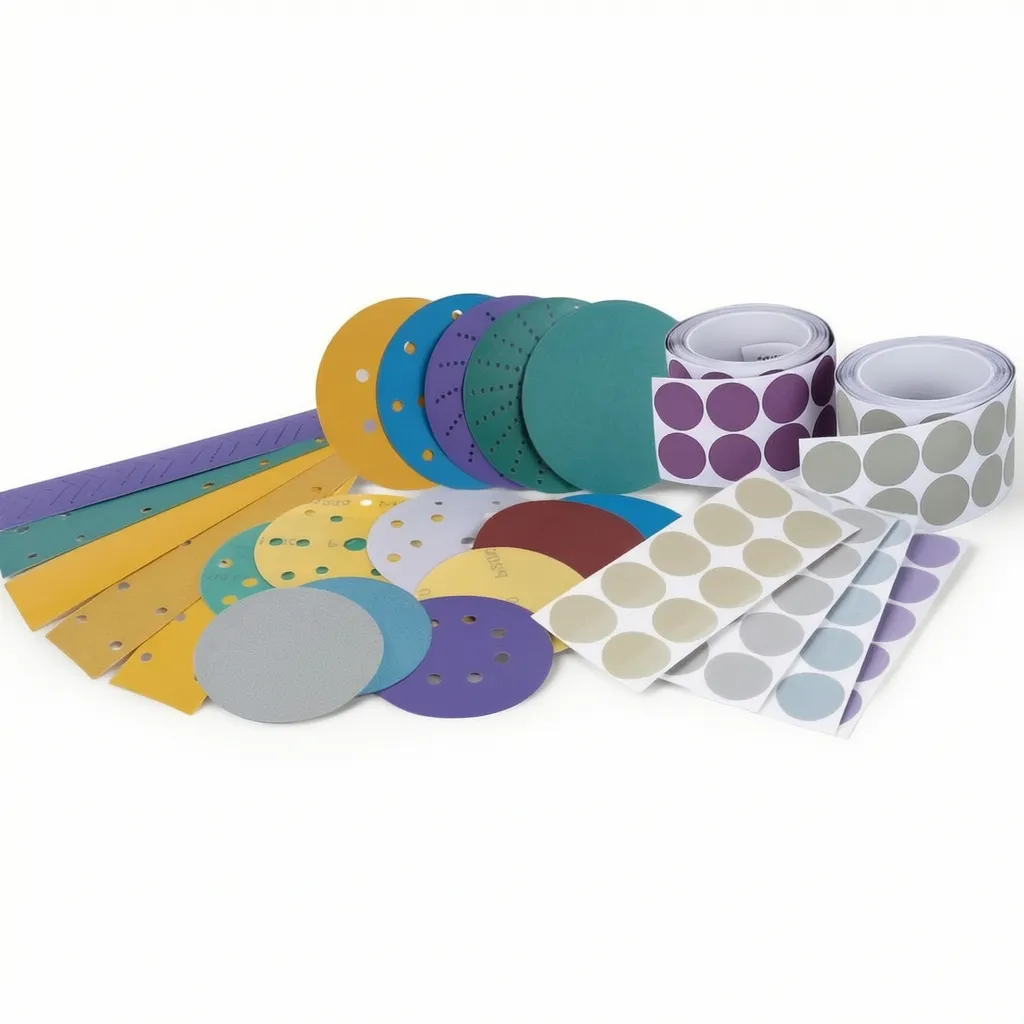
Any seasoned woodworker will tell you that the backing on an abrasive is just as critical as the grit glued to it. Cloth backings flex and tear less under heavy hand pressure or on belt sanders, which makes them the go-to for metalwork and aggressive stock removal. Paper, by contrast, has almost no stretch, so it delivers a flatter, more consistent scratch pattern on fine finishing tasks. Film backings sit somewhere in between—tough, waterproof, and thin enough to keep edges crisp when you’re working close to a veneer line.
But does it actually matter in practice? If you’ve ever had a disc explode on a high-speed grinder or watched a paper sheet turn to mush the moment it touched water, you already know the answer. Film backing eliminates most of that guesswork, especially on random-orbit sanders where the backing has to survive constant flexing and dust extraction. For hand sanding painted trim, though, a stiff paper sheet often gives you better control and a cleaner line without rolling over the edge.
So the choice isn’t about one being universally better—it’s about matching the backing to the tool and the surface. Cloth for heavy abrasion and contoured shapes, paper for flat machine sanding and dry fine work, film for wet applications and precise edge retention. Ignore the backing and you’ll either waste abrasive or burn through more material than you intended.
Reading the Fine Print on Abrasive Labels
Ever flip over a sanding disc and squint at that tiny grid of letters and numbers? Those aren't just for inventory nerds. The alphanumeric code tells you the abrasive grain, bond type, and even the backing weight—details that decide whether your disc loads up in seconds or chews through maple like butter. For example, a “C” weight paper backing bends easily for contours, while an “X” weight cloth survives a floor sander's fury. Skip the fine print, and you'll burn through discs, gouge the workpiece, or wonder why your “120 grit” feels like gravel from a driveway.
Grit numbers get all the glory, but the real troublemakers lurk elsewhere on the label. Look for the coating type: open-coat means the grains are spaced out, so sawdust and paint don't clog the surface—perfect for softwoods or resinous pine. Closed-coat packs grains tight for a finer finish on metal or hardwood. Then there's the bond: resin bonds handle heat better than hide glue, which matters when you're grinding welds or sharpening lathe tools. If the label just says “premium” without specifics, treat it like a candy bar labeled “natural”—marketing, not data.
And don't forget the fine print about speed limits and storage. Some discs are rated for a maximum RPM, and running them faster turns the backing into confetti. Moisture warnings matter too: a damp basement can ruin a stack of aluminum oxide sheets before you even open the box. Next time you're in the abrasives aisle, take thirty seconds to read past the big grit number. Your fingertips and your project's surface will both be glad you did.
How to Spot Inconsistent Grain Distribution Before You Buy
Most buyers judge only the show face, but that's exactly where sellers hide the best-looking grain. Flip the piece over. Run your palm across the back and edges—if the surface alternates between slick and grabby, the grain direction is reversing. That reversal is a solid clue that internal stresses are already present, even if the top looks flawless.
Hold a flashlight or your phone at a low angle, almost parallel to the surface. This raking light exaggerates any undulation where the grain bunches up or spreads out. On end grain, check whether the growth rings stay roughly parallel and evenly spaced across the board's width. If you see tight lines suddenly stacked next to wide, lazy curves, expect the piece to cup or twist after you bring it home.
For rough-sawn or live-edge stock, follow the grain into knots and around curves. A line that flows straight into a knot and then reverses direction creates a built-in hinge point. If you're choosing dimensioned lumber, compare both end cuts—if the ring spacing looks noticeably different from one end to the other, the board was likely cut from a small or crooked log. Either negotiate the price down or keep looking.
Matching Abrasive Type to Your Tool’s Speed and Pressure
Grinding and sanding are rarely about forcing the abrasive into the work. The real control comes from matching the grain’s fracture characteristics to the energy input from your tool. High-speed angle grinders above 10,000 RPM tend to shatter hard but brittle grains like silicon carbide before they can cut, while softer aluminum oxide holds up better because it sheds dulled edges gradually. Pressure, not just speed, changes the equation: heavy downward force on a low-speed sander calls for a tougher ceramic or zirconia blend that resists flattening.
Ceramic abrasives, for example, thrive under high pressure and moderate speed because they micro-fracture to expose fresh cutting points. If you run them on a low-pressure random orbital sander, they may glaze over instead. On the opposite end, silicon carbide works well for soft metals and nonmetals at lower speeds, but it degrades fast when pushed hard against steel. A useful trick is to watch the dust. Fine, powdery dust usually means the grain is dulling too fast for the pressure; chunky or stringy swarf suggests the abrasive is cutting efficiently without overheating.
Don’t ignore the backing and bond either. A stiff fiber disc can tolerate more pressure than a thin film sheet, even with the same abrasive type. If you notice burn marks or a glossy surface, reduce pressure or switch to a cooler-cutting grain like aluminum oxide. Matching abrasive to tool speed and pressure isn’t a fixed chart—it’s a feel for how the grain breaks down under your specific setup, and small adjustments often save both time and material.
The Hidden Cost of Cheap Abrasive Paper: Burn Through and Rework
Cheap abrasive paper often tempts with a low upfront price, but that savings evaporates the moment you scorch a clear coat or slice through a primer layer. The grit inconsistency in budget sheets doesn't just leave uneven scratches—it concentrates heat in narrow bands, turning a routine sanding pass into a burn-through disaster. Once the damage is done, you're not just respraying a panel; you're feathering edges, re-priming, and praying the blend doesn't show under shop lights.
Rework is where the real cost hides. A single burn-through on a curved bumper can add hours of labor, extra materials, and a frustrated customer waiting on a promise you can't keep. Premium abrasives with stearate coatings and uniform grain distribution cut cooler and clog less, letting you work edges and contours without flirting with failure. The price difference per sheet becomes irrelevant when compared to the cost of redoing a job twice.
Shops that chase cheap paper often end up paying for it in rework loops—sanding too aggressively to remove coarse scratches, then burning through trying to fix the mess. The smart move isn't buying the most expensive sheet, but matching the abrasive to the substrate and accepting that a few extra cents per disc buys predictability. Burn-through isn't just a mistake; it's a tax on choosing the wrong tool for the job.
FAQ
Focus on uniform grain distribution, a sturdy backing that resists tearing, and consistent bonding between the abrasive and the backing. High-quality sheets tend to cut evenly and last longer without shedding grit.
Start with a coarser grit to remove material or old finish, then move to medium grits for smoothing, and finish with fine grits for surface prep. The right sequence shortens work time and reduces visible scratches.
For wood, a flexible paper or cloth backing follows contours without cracking. For metal, a heavier cloth or fiber backing holds up better under pressure and heat, especially when using power tools.
Aluminum oxide is versatile and self-sharpening, making it a solid all-rounder. Silicon carbide works well on harder surfaces or for wet sanding, while ceramic grains cut aggressively on tough materials.
Look for clear product specs, consistent availability across grits, and a willingness to provide samples or technical data. A supplier that asks about your project needs is more likely to offer paper that performs well.
Yes. Open-coat has gaps between grains, so it resists clogging when sanding soft or resinous woods. Closed-coat packs grains tightly, giving a smoother finish on harder surfaces but loading up faster with dust.
Keep sheets flat and away from moisture or extreme temperature swings. Hanging belts or discs prevents creases, and separating grits in labeled folders saves time and avoids accidental cross-contamination.
Conclusion
Choosing quality abrasive paper isn't about grabbing the highest grit number on the shelf—it's about understanding how the grit actually behaves on your specific surface. A coarse 40-grit may chew through material fast but leave deep scratches that demand extra steps later, while a fine 220-grit on rough wood will clog within seconds and waste your time. The backing material quietly shapes performance too: paper tears under heavy hand sanding but gives a crisp finish on flat surfaces, cloth flexes around curves without cracking, and film delivers ultra-consistent thickness for fine finishing. Don't ignore the fine print on the label either—look for the abrasive type (aluminum oxide, silicon carbide, ceramic), the bond resin, and whether it's closed or open coat, because these details determine how long the sheet stays sharp and how much heat it builds up.
Before you buy, hold the sheet up to a light and run your fingers across it. Inconsistent grain distribution shows up as patchy dull spots or uneven texture, which leads to swirl marks and uneven stock removal. You also need to match the abrasive to your tool's speed and pressure: a brittle ceramic grain may shine on a high-speed orbital sander but shatter under a low-speed drill attachment. Cheap abrasive paper often hides its true cost in burn-through, rework, and ruined workpieces—saving a few pennies per sheet can easily cost you hours of repair and a full resand. A reliable supplier will be upfront about these specs and help you pick a product that holds up from first pass to final polish, rather than pushing the cheapest roll on the rack.
Contact Us
Contact Person: Amanda Wang
Email: [email protected]
Tel/WhatsApp: +86-13602569854
Website: https://www.sunabrasives.com.cn