

Spiral Freezer Recommendations: Expert Picks for Optimal Food Freezing
2026-07-12
In the competitive realm of food freezing, a spiral freezer can make or break your production line—affecting everything from texture to shelf life. Sifting through countless options is daunting, but our experts have done the legwork to highlight the most efficient, reliable models on the market. Get ready to explore top-tier recommendations that balance performance and cost, with trusted guidance from Worldbase.
Why Spiral Freezers Beat Conventional Methods
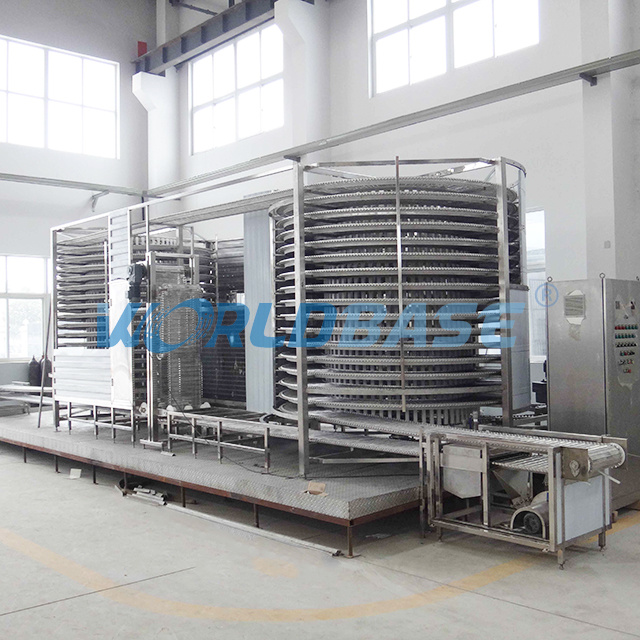
Spiral freezers fundamentally rethink how products move through the freezing process. Instead of relying on static racks or linear conveyors that force food into a single, slow-moving stream, a spiral system stacks the belt into a compact vertical coil. This design keeps product continuously moving in a controlled, uniform path, exposing every item to the same chilled airflow for the same amount of time. The outcome is a much faster, more predictable freeze that preserves texture and flavor far better than conventional methods, which often leave some pieces overfrozen and others still soft in the middle.
One of the less obvious advantages is how a spiral freezer handles shape and space. Conventional air blast or tray systems demand wide footprints and often struggle with irregularly shaped products, creating dead spots where cold air can’t reach. In a spiral, the belt pitch and air direction can be tuned so that even oddly shaped items—think stuffed pastas or deboned poultry—freeze evenly without sticking together or deforming. That flexibility means fewer product losses and less need for manual sorting downstream, directly trimming operating costs in a way a standard tunnel freezer rarely can.
Energy efficiency tends to tilt in favor of the spiral, too. Traditional blast freezers push cold air across large, often poorly sealed chambers, losing a significant amount of cooling capacity to the surrounding workspace. A well-designed spiral uses its vertical geometry to contain the cold within a smaller, insulated column, recirculating air more effectively and reducing the load on compressors. Add in features like sequential defrosting and variable-speed drives that match belt speed to product load, and the kWh per kilogram frozen can drop considerably—making the spiral not just a smarter freezing tool, but a quieter partner in a plant’s overall energy budget.
Sizing Up Your Production Line Needs
Figuring out the right scale for a production line is rarely a simple calculation. It starts with a clear-eyed look at current demand, but the real trick is mapping out how that demand might shift in the next eighteen months. Too often, businesses either overbuild and bleed cash on idle machinery, or they undershoot and find themselves turning away orders. The sweet spot sits somewhere between flexibility and focus—enough capacity to handle peak bursts without forcing you to carry excessive overhead during the slow weeks.
Beyond raw volume, you’ve got to factor in the nature of what you’re making. High-mix, low-volume runs call for quick changeover and modular setups, while a single product flying off the shelves might justify dedicated, hard-tooled automation. It helps to walk the floor and watch how materials actually flow, because bottlenecks have a way of hiding in plain sight. Maybe your mixer can keep up but your packaging station can’t, or vice versa. Lining up each step honestly keeps you from buying a Ferrari engine for a go-kart chassis.
Don’t overlook the people side, either. A gleaming new line won’t deliver if your crew isn’t ready to run it, maintain it, and troubleshoot on the fly. Sometimes the smarter move is boosting output by tweaking shift patterns or cross-training operators rather than bolting on more machines. And always leave a little breathing room—demand forecasts have a way of getting fuzzy, and the lines that survive market swings are usually the ones that can dial up or down without a complete rebuild.
Energy Efficiency That Cuts Costs
Smarter energy use isn’t about grand gestures—it’s in the overlooked corners of daily operations. Many companies bleed money through idle equipment, outdated lighting schedules, and heating systems that run at full tilt in empty rooms. By targeting these invisible leaks, businesses often shave 15–30% off utility bills without a single capital investment. The trick is to treat energy like inventory: something you track, measure, and fiercely protect from waste.
What sets the savviest operators apart is how they make efficiency stick. Instead of a one-time audit that gathers dust, they build it into team rhythms—tying thermostat adjustments to shift changes, linking machine warm-up cycles to actual demand, and giving department leads real-time cost feedback. When you turn power consumption into a shared metric rather than a facilities-only concern, the savings compound month after month.
Quick-Freeze Tech for Better Texture
There’s a quiet art to flash freezing. By plunging ingredients into a hyper-cold environment within seconds, the water inside forms tiny, uniform ice crystals instead of the jagged shards you get from a slow home freezer. That gentle structure is the reason the cell walls of a strawberry stay intact, leaving you with a fruit that still has a little bite, not mush. It’s texture by subtraction—taking away the damage before it can start.
What’s interesting is how this influences the eating experience beyond just initial firmness. In things like gelato, rapid freezing traps air in a finer matrix, so it feels denser and smoother on the tongue, almost velvety. With vegetables, it’s the difference between a snap and a sigh. The quick-freeze process keeps the natural pectin and fiber scaffold from collapsing, so when you thaw, you’re tasting structure, not just softened matter.
There’s also a subtlety in how this tech preserves the chatter between flavor and mouthfeel. Because less moisture migrates and recrystallizes over time, the surface of the food doesn’t become spongy or leathery. Whether it’s a peach slice holding its shape or a piece of fish that still flakes cleanly, quick-freezing works behind the scenes, quietly upholding the promise of the ingredient’s original character.
Maintenance Habits That Extend Lifespan
A surprising number of people think maintenance means waiting for something to break. That reactive approach is exactly what shortens the lifespan of everything from engines to relationships. Real longevity comes from the small, consistent acts that feel almost boring in the moment—like checking fluid levels before they trigger a warning light, or tightening a loose screw before it becomes a stripped thread. These aren't exciting tasks, but they compound into something remarkable: equipment that runs smoothly year after year, without dramatic breakdowns or costly rebuilds.
Another underrated habit is documentation. Not just service records, but actual notes on how something behaves under different conditions. That faint hum that only appears on cold mornings? Jot it down. The belt that seems to wear slightly faster on one edge? Make a note. Over time, these observations create a personalized operating manual that no manufacturer could ever provide. It’s the difference between blindly following a generic schedule and truly understanding the rhythms of your machinery.
Then there’s the habit of using parts and fluids that match the operator’s reality, not just the spec sheet. Environments vary wildly. High humidity, stop-and-go usage, dust—these aren’t flaws in the design, they’re just context. Adjusting maintenance intervals and material choices accordingly isn’t overkill; it’s respect for the fact that a machine doesn’t live in a lab. That kind of thoughtful adaptation is what keeps things alive long past their expected expiration date.
Real-World Wins from Food Processors
A small bakery in rural Vermont cut daily prep time by nearly two hours after swapping their old spiral mixer for a food processor with interchangeable blades. What used to require separate rounds of kneading, shredding, and emulsifying now happens in a single bowl, freeing staff to focus on custom cake orders that actually grow the bottom line.
At a bustling canteen in Singapore, swapping bulky standalone blenders and graters for a single high-powered food processor didn’t just reclaim precious counter space—it halved the average ticket time for their signature laksa paste. Consistency improved too, because the pulse function gives cooks tactile control that pre-programmed gadgets never quite matched.
A family-run catering business in Lisbon struggled with uneven chopping for their event-sized batches until they started using a food processor with a wide feed tube and sealed bowl. The result: zero wrist strain from hand mincing, far less food waste from knife-fumbled veg, and rave reviews from clients who noticed the texture difference in every bite.
FAQ
A spiral freezer uses a continuous belt system that coils upward in a helical path, saving floor space while maximizing freezing time. Unlike flat belt or tunnel freezers, it can handle large volumes in a compact footprint, making it ideal for high-capacity food processing lines where space is tight. The design allows products to enter at one level, spiral up or down, and exit fully frozen.
Spiral freezers excel with items that need gentle handling and individually quick freezing (IQF), such as chicken nuggets, seafood portions, bakery goods, and ready meals. The even airflow and adjustable belt speed prevent clumping and preserve texture, so delicate products like breaded shrimp or pastries come out intact without sticking together.
Start by calculating your required throughput in pounds or kilograms per hour, considering peak demand and future growth. Factor in the freezing time for your thickest product—this dictates belt speed and dwell time. Work with a manufacturer to model airflow and belt width; a freezer that’s too small will bottleneck your line, while oversized units waste energy. Don’t forget to account for floor space, ceiling height, and product height on the belt.
Prioritize robust, all-stainless steel construction and a self-stacking belt system that reduces maintenance. Look for optimized airflow patterns—vertical or horizontal air circulation that uniformly freezes without freezer burn. Ease of cleaning is paramount, so opt for CIP (Clean-in-Place) compatibility and sloped floors for drainage. A well-designed unit also minimizes belt tension and wear, extending belt life.
Modern spiral freezers use variable-speed fans and demand-based defrost cycles to cut energy use significantly. Many can pair with ammonia or CO2 refrigeration systems, which have lower global warming potential. Insulated enclosures and efficient air curtains at entry/exit points reduce cold loss. Some even recover waste heat for facility heating or hot water, turning the freezer into part of a plant-wide energy loop.
Regular inspection of the belt, bearings, and drum motor is non-negotiable. Keep air coils clean—ice buildup wrecks efficiency. Implement a proactive sanitation schedule to prevent bacterial growth, especially in wet environments. Monitor belt tension and tracking weekly, and replace worn components before they fail. Training operators to spot early signs of trouble, like unusual vibrations or temperature fluctuations, can avert costly breakdowns.
Conclusion
When evaluating freezing solutions, spiral freezers consistently outperform conventional blast and tunnel systems by combining smaller footprints with faster, more uniform cooling. Their continuous, automated product flow drastically reduces freeze times and minimizes dehydration, locking in freshness without ice crystal damage. For processors scaling up, it's critical to match belt width, tier count, and dwell time to projected throughput, ensuring the system can handle peak loads without creating bottlenecks. Modern units with variable-speed drives and demand-based defrost cycles can cut energy use by up to 30%, delivering a swift return on investment. Advanced airflow dynamics and precisely controlled low temperatures further enhance texture, yielding firmer seafood, juicier poultry, and intact berry structure that stands out on store shelves.
Long-term reliability hinges on proactive maintenance: regular coil inspections, belt tension checks, and lubricant monitoring prevent unplanned downtime and extend equipment lifespan well beyond a decade. Real-world results speak volumes—mid-sized bakeries have halved freezing time for par-baked goods while bakeries and fruit processors report fewer product losses and consistent premium quality. Choosing the right spiral freezer isn't just about the upfront specs; it's about aligning the technology with your product's unique thermal profile and your facility's growth plans. Partnering with experts who understand both the engineering and the food science ensures you won't outgrow your system. In a market where shelf life and sensory appeal dictate buyer decisions, a well-chosen spiral freezer is a strategic asset, not merely a utility.
Contact Us
Contact Person: Mr Yang
Email: [email protected]
Tel/WhatsApp: +8613809083091
Website: https://en.worldbase.cn