
Top Concrete Mixing Plant Supplier for Reliable Concrete Production
2026-11-02
Concrete production lives or dies by the consistency of your mixing plant. One overlooked component can stall an entire pour, eating into deadlines and profit. That’s why choosing a supplier isn’t just about specs—it’s about trust. Qianfeng Electromechanical Equipment has earned that trust by helping contractors keep every batch on time, on spec, and on budget. Here’s what sets them apart.
What Defines a Dependable Concrete Mixing Plant Partner
A dependable partner doesn't just sell you equipment—they understand your production cycles, your aggregate sources, and the pressure of keeping pours on schedule. Look for a supplier who asks about your typical batch sizes and delivery windows before discussing specs. That kind of front-end curiosity usually signals a team that will still pick up the phone when a sensor fails at 5 a.m.
Reliability also shows up in the details that don't make the brochure: how quickly they stock wear parts locally, whether their technicians have experience with your specific mixer model, and if they offer calibration support after installation. A partner worth keeping will have a service van within a few hours of your site, not a call center three time zones away.
Finally, watch how they handle mistakes. Every plant has downtime at some point. The partner you want is the one who owns the problem, gives you a realistic timeline, and sends a person—not just a tracking number—to make it right. That's the difference between a vendor and a long-term ally on the pour line.
Core Engineering Features Behind Consistent Output
Consistency in system output rarely happens by accident. It starts with deterministic design: every processing path is explicitly ordered, and components avoid hidden state or race conditions. For example, request handling follows a fixed sequence—validation, transformation, then response assembly—so the same input always travels through the same logic, producing identical structure and timing characteristics.
Automated regression suites play a second, equally important role. Each change to the codebase triggers a battery of tests that compare outputs against known baselines, not just for correctness but for formatting, field ordering, and numeric precision. This catches subtle drift early, before it ever reaches a user. The test data itself is versioned, ensuring that past edge cases remain active checks rather than forgotten history.
Finally, environment reproducibility ties everything together. Dependencies are pinned to exact versions, build flags are recorded, and runtime configurations are treated as code. Deployments happen from immutable artifacts, so no matter where the service runs—local laptop, staging cluster, or production—the output path stays identical. Small operational details like log rotation and cache warming are also scripted, removing the last bits of human variability.
How Intelligent Controls Reduce Batch Variability
Modern production lines face a constant struggle: keeping every batch identical when raw materials, ambient conditions, and equipment wear shift by the hour. Intelligent controls tackle this by continuously reading real-time sensor data—temperature, viscosity, pressure, mixing speed—and adjusting process parameters on the fly. Instead of relying on a fixed recipe, these systems learn from each cycle, compensating for drift before it becomes a visible defect. The result is a dramatic narrowing of the distribution curve for critical quality attributes, even when upstream inputs vary beyond normal limits.
A key mechanism behind this consistency is model predictive control paired with multivariate feedback. Rather than responding to one variable at a time, intelligent controls map how multiple inputs interact—for example, how a slight increase in ambient humidity slows drying and alters final moisture content. By predicting the downstream effect of current deviations, the controller can preemptively adjust airflow or residence time. This reduces overcorrection, a common source of batch-to-batch swings in traditional PID loops, and keeps the process centered on the target instead of oscillating around it.
Beyond live adjustment, intelligent controls also capture a rich history of every batch, including the hidden measurements that never appear on a standard batch record. Over time, pattern recognition algorithms spot weak correlations—say, a specific raw-material lot combined with lower agitator torque leading to subtle color shifts. Operators receive early warnings and suggested setpoint changes, turning tribal knowledge into data-driven guardrails. The compounding effect is a line that self-stabilizes, cutting variability not by imposing tighter specifications, but by understanding and neutralizing the root causes of drift.
Material Handling Systems That Prevent Contamination
In environments where even microscopic particles can ruin a batch, the way materials move matters as much as the materials themselves. Closed transfer systems, isolator-compatible bins, and single-use fluid paths are common building blocks. The goal is never just speed—it’s keeping product contact surfaces sealed off from operator intervention, room air, and cross-traffic.
Some operations rely on split butterfly valves for contained docking, while others prefer disposable bag-in-bottle or tube-welding approaches that remove cleaning validation burdens. The right choice depends on whether the risk sits with potent compounds, biologics, or aseptic fill lines. Smart facilities pair these systems with glove ports, restricted access barriers, and laminar flow hoods so that loading and unloading do not become contamination events in themselves.
Beyond hardware, contamination prevention is a matter of choreography. Gravity rollers, lift assists, and mobile lifts are positioned to minimize repetitive motions and accidental breaches. When material handling equipment is easy to wipe down, designed with sloped surfaces, and built from 316L stainless steel or FDA-approved polymers, it becomes part of the cleanroom’s contamination control strategy rather than a weak link.
Real-World Performance in Large Infrastructure Projects
When a multi-billion-dollar transit expansion opens years behind schedule, the public rarely hears about the thousands of daily micro-decisions that kept the project moving at all. Real-world performance in large infrastructure is rarely a story of perfect planning; it is a story of how teams absorb uncertainty, recalibrate scope, and keep physical work progressing when specifications, ground conditions, and funding streams shift mid-stream. The gap between design models and constructed reality often becomes the true measure of project health.
On major bridge, tunnel, and rail programmes, schedule slippage is usually traced to a handful of systemic frictions: delayed utility relocations, inconsistent geotechnical data, or procurement bottlenecks that force contractors into idle wait states. Yet the projects that hold their critical path do not avoid these frictions; they build early warning systems around them. Weekly look-ahead meetings become less about blame and more about measuring the ratio of planned to actual crew hours, tracking material delivery variability, and identifying which approved submittals are actually being used in the field.
What separates resilient delivery teams is their tolerance for honest variance. Instead of hiding behind earned-value percentages, they publish rolling forecasts that show a range of completion dates, each tied to a specific risk trigger. That transparency allows owners to make earlier trade-off calls—accelerating a segment, descoping a non-critical feature, or resequencing interfaces with adjacent contracts. In the end, real-world performance is not a single KPI but a discipline of seeing the project as it is, not as the baseline says it should be.
Service Depth That Keeps Production Running
Real service depth starts before anything breaks. It means walking the floor with your maintenance team, learning which conveyors run hot on second shift, where the coolant lines tend to clog, and why that one packaging cell trips its breaker every few weeks. Instead of waiting for a fault code, a deeply engaged service partner checks torque values, vibration signatures, and belt tensions during routine visits — catching drift long before it becomes downtime.
When a line does go down, depth shows up as more than a phone call. The right team has local stock of critical spares, knows the PLC logic well enough to remote in without a site walkthrough, and brings a backup plan for the backup plan. They don't just swap a failed drive; they trace the root cause back to a power quality issue, then work with your electricians to fix the ground loop that would have killed the next drive too.
Over time, that depth compounds. Service reports stop being checklists and become actual decision tools — showing which machines cost the most per hour of runtime, where minor adjustments reduce scrap, and when a rebuild beats a replacement. This kind of embedded support lets production managers sleep at night, not because nothing ever fails, but because every failure has a known path back to full speed.
FAQ
Focus on batching accuracy, mixing homogeneity, and how the control system handles fluctuations in raw material moisture. A supplier with a track record in your specific climate and aggregate types usually saves more trouble than one offering only a low sticker price.
If your jobsite will run for several years with high daily output, a stationary plant usually pays off through faster cycle times and easier automation. Mobile units make more sense when you need to relocate every few months or serve scattered small pours.
Twin-shaft mixers tend to deliver faster, more uniform blending for standard mixes, while planetary mixers handle stiff or specialty mixes better. Matching mixer design to your most common recipes prevents long mixing times and uneven slump.
A well-designed control system catches dosing drift early, stores mix recipes without errors, and gives operators clear diagnostics. That reduces batch rejects and keeps production moving when less experienced staff are on shift.
Ask about spare parts availability in your region, typical response time for service calls, and whether they provide remote troubleshooting. Better suppliers will share actual reference sites and let you talk to plant operators, not just sales staff.
Often yes. Better wear plates, higher-quality motors, and more precise weighing systems reduce downtime and rework. Over a five-year span, spending 15–20% more upfront can easily return double that through fewer lost production days.
Daily checks on mixer wear, air compressor drainage, and sensor calibration go a long way. Scheduling a thorough inspection every 500 operating hours, especially for bearings and seals, prevents most unexpected breakdowns.
Very important. Cold regions need heating systems for aggregates and water, while humid areas demand better corrosion protection and electrical enclosures. A supplier familiar with your local conditions will spec these correctly from the start.
Conclusion
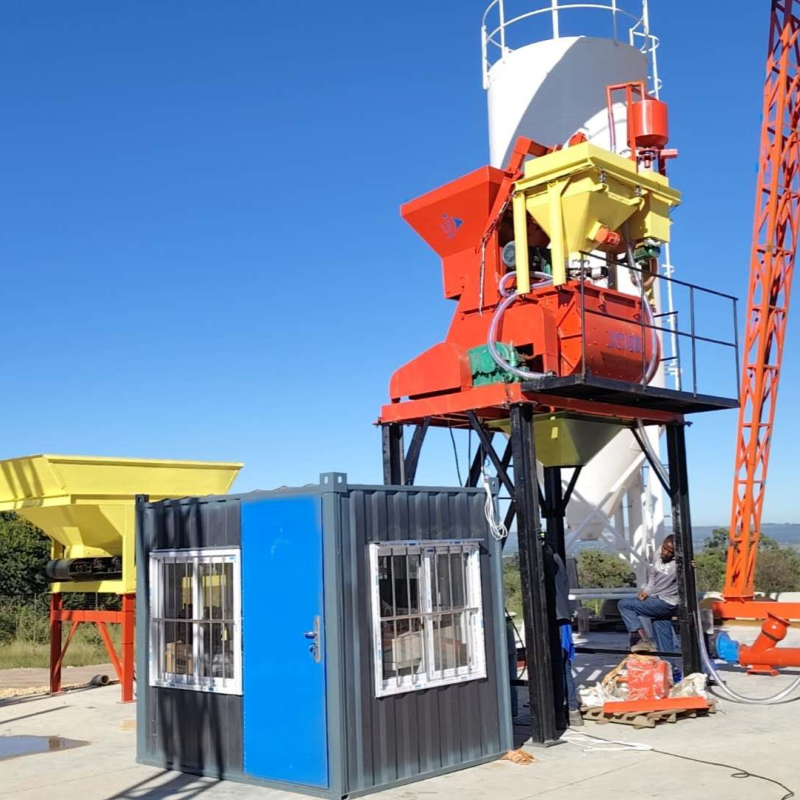
A top concrete mixing plant supplier earns that title by doing more than selling equipment. It becomes a long-term partner in reliable production, starting with engineering discipline that keeps every batch within spec. The best plants combine heavy-duty twin-shaft mixers, fast discharge gates, precise load-cell weighing, and intelligent control systems that automatically adjust for moisture and aggregate variations. That means variability between batches stays minimal even on long pours, and the mix remains workable from first yard to last. Material handling is equally deliberate: separate storage compartments, sealed conveyors, and sequenced batching prevent cross-contamination and preserve mix integrity from silo to truck. These are not add-ons but core features that separate a dependable plant from one that only works under ideal conditions.
On large infrastructure projects—bridges, dams, airport runways—this reliability shows up as predictable slump, consistent strength development, and fewer rejected loads. But performance alone isn't enough. A supplier that keeps production running also maintains local parts inventories, dispatches technicians quickly, and offers operator training that goes beyond basic startup. That depth of service turns a solid machine into a dependable production system. When downtime is expensive and specifications are tight, the right supplier is the one whose engineering, controls, material handling, and support all point toward the same outcome: concrete you can trust, batch after batch, season after season.
Contact Us
Contact Person: Bill
Email: [email protected]
Tel/WhatsApp: 8615063653526
Website: https://www.qianfengjd.com